Every moving vehicle generates a turbulent wake, an induced wind currently dissipated without being exploited. This project explores capturing that kinetic energy along roads and railways using a vertical-axis wind turbine (VAWT), converting it into local, decentralized electricity for applications such as rural LED lighting.
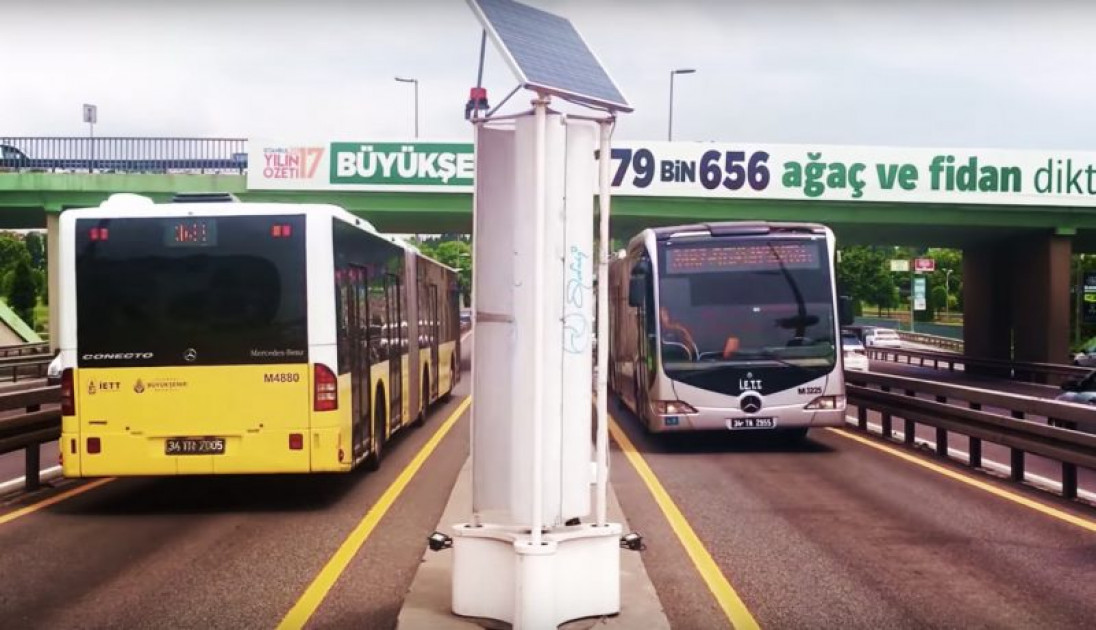
Project carried out with one teammate. I was responsible for the turbine's functional specification and the full aerodynamic design chain, energy resource characterization, rotor configuration selection, blade count and airfoil selection, and the aerodynamic force model.
Defined the cahier des charges covering power target, wind speed range, rotor dimensions, mast height, materials, safety and maintenance requirements.
Modeled the kinetic energy and power available from vehicle-induced wind, using Betz's theorem to establish the theoretical recovery limit.
Compared Darrieus and Savonius architectures and selected an H-Darrieus, 3-blade configuration for its efficiency-to-weight ratio and mechanical simplicity.
Selected the LS413 airfoil for its lift and moment characteristics, and set rotor solidity to control torque behavior across the operating range.
Developed a Python program computing lift, drag, normal, tangential and resultant forces on each blade as a function of azimuthal angle and tip-speed ratio, from interpolated Cl/Cd airfoil data.
The turbine was specified to charge a 12 V battery (7-20 Ah) for rural LED lighting, under constraints on size, weight, safety and maintainability suited to roadside installation.
| Parameter | Requirement |
|---|---|
| Power output | 50 - 150 W |
| Minimum operating wind speed | 2.5 - 3 m/s |
| Mast height | ≤ 6 m |
| Rotor diameter | 0.8 - 1.5 m |
| Rotor height | 1 - 2 m |
| Maximum wind resistance | ≥ 100 km/h |
| Total weight | < 50 kg |
| Generator efficiency target | > 60% |
| Estimated service life | 5 - 10 years |
| Vehicle Speed (km/h) | Induced Wind Speed (km/h) |
|---|---|
| 30 | 33.02 |
| 50 | 64.03 |
| 80 | 93.74 |
| 100 | 115.54 |
Induced wind speed exceeds vehicle speed above roughly 50 km/h, is unaffected by altitude, and is more predictable than natural wind, a stable resource for turbine sizing.
No wind turbine can convert more than 59.3% of the kinetic energy of the wind into mechanical energy (Betz, 1919). This theoretical ceiling was used to bound the achievable power coefficient Cp before selecting a realistic value for the retained VAWT architecture.
| Turbine Type | Typical Cp Range |
|---|---|
| Horizontal-axis wind turbine (HAWT) | ≈ 0.45 |
| Vertical-axis : Darrieus | 0.10 - 0.30 |
| Vertical-axis : Savonius | 0.05 - 0.15 |
Darrieus and Savonius architectures were compared; Darrieus was retained for its higher efficiency and lower weight. Among Darrieus sub-configurations (eggbeater, H-type, V-type), the H-Darrieus was selected for its mechanical simplicity and stable torque output.
H-Darrieus, 3 blades, balances aerodynamic efficiency, structural simplicity and manufacturability.
LS413 profile, selected for its lift and pitching-moment characteristics at the target tip-speed ratio.
Rotor solidity sized to control torque behavior and starting performance across the operating tip-speed-ratio range.
A Python program was developed to compute the aerodynamic loading on each blade over a full rotation: attack angle from θ and tip-speed ratio λ, interpolated Cl/Cd coefficients from an airfoil polar dataset, and the resulting lift, drag, normal, tangential and resultant force components.
Building on the aerodynamic loads, the drive shaft and bearings were sized as a joint team deliverable, applying the von Mises criterion under combined bending and torsion loading.
Beyond the analytical and computational design work, the turbine was physically fabricated and assembled by the team into a working prototype.
The project demonstrated the technical feasibility of recovering vehicle-induced kinetic energy with a compact vertical-axis turbine, from resource characterization and Betz-limited power estimation, through rotor configuration and airfoil selection, to a custom aerodynamic force model and a fabricated prototype.